
How to Improve Your English Speaking Skills for the IELTS Exam
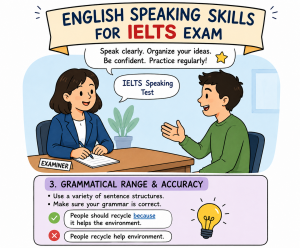
The IELTS Speaking test is one of the most nerve-wracking parts of the entire exam — and it’s easy to see why. You’re sitting face-to-face with an examiner, expected to speak fluently, coherently, and confidently in a second language. But here’s the truth: speaking well for IELTS is a skill you can practise and master. It’s not about having a “perfect” accent or using complicated vocabulary — it’s about communicating clearly and naturally.
This guide breaks down exactly what the IELTS examiner is listening for and gives you practical exercises to build your speaking skills from the ground up.
Understanding What the Examiner Is Looking For
Before diving into tips, you need to know how you’re scored. The IELTS Speaking test is marked on four criteria, each worth 25% of your final band score:
- Fluency and Coherence — Can you speak at a natural pace without long hesitations? Do your ideas connect logically?
- Lexical Resource — Do you use a wide range of vocabulary accurately and appropriately?
- Grammatical Range and Accuracy — Can you use a variety of sentence structures with minimal errors?
- Pronunciation — Is your speech easy to understand? Do you use stress and intonation naturally?
Knowing these four areas helps you focus your practice instead of just “speaking more English” aimlessly.
1. Practise Speaking Every Single Day
Consistency beats intensity. Fifteen minutes of speaking practice every day will improve your fluency far more than a three-hour session once a week. The goal is to make English your default mode of thinking and expression.
Daily speaking exercises:
- Talk to yourself — narrate your day, describe what you see around you, or explain what you’re doing. It sounds odd, but it works remarkably well for building spontaneous speech.
- Record yourself — use your phone to record a 2-minute talk on any topic. Play it back and listen critically. You’ll immediately hear hesitations, repeated words, and pronunciation issues you didn’t notice while speaking.
- Mirror practice — speaking in front of a mirror helps you become comfortable with the physical act of speaking in English and builds confidence for face-to-face situations like the IELTS test.
2. Master the Three Parts of the IELTS Speaking Test
The IELTS Speaking test is divided into three distinct parts. Tailoring your practice to each one is essential.
Part 1 — Introduction and Interview (4–5 minutes)
The examiner asks you questions about familiar topics: your hometown, hobbies, work, or family. These are warm-up questions, but don’t underestimate them.
How to practise: Make a list of 20 common Part 1 topics (home, travel, technology, food, sports) and practise giving 2–3 sentence answers. Avoid one-word answers — always extend with a reason or example. Instead of “I like reading,” say “I love reading, especially historical fiction, because it lets me explore different time periods while improving my vocabulary at the same time.”
Part 2 — Individual Long Turn (3–4 minutes)
You receive a cue card with a topic and have 1 minute to prepare a 1–2 minute talk. This is where many candidates freeze or run out of things to say.
How to practise: Use the PEEL structure to organise your response:
- Point — state your main idea
- Evidence — give a specific example or detail
- Explain — elaborate on why it matters
- Link — connect back to the question
Practise timed talks daily. Download past IELTS cue cards from online resources and time yourself. The goal is to speak for the full two minutes without running dry.
Part 3 — Two-Way Discussion (4–5 minutes)
The examiner asks abstract, analytical questions linked to the Part 2 topic. This is the most challenging part because it requires critical thinking in real time.
How to practise: Read opinion articles on topics like education, environment, technology, and society. After reading, close the article and speak your opinion aloud for 60 seconds. This trains you to form and express arguments quickly.
3. Expand Your Vocabulary the Smart Way
Lexical resource doesn’t mean memorising long lists of complex words. It means being able to use the right word at the right time naturally.
Practical vocabulary exercises:
- Learn words in context — instead of learning isolated words, learn them in phrases. Don’t just learn “environment” — learn “raise environmental awareness,” “tackle environmental issues,” “sustainable development.”
- Use topic-based word maps — pick an IELTS topic (e.g., technology) and create a mind map of 15–20 related words and phrases. Practise using all of them in a 2-minute spoken response.
- Avoid repetition — one of the most common mistakes is repeating the same word multiple times. Practise using synonyms. Instead of saying “good” repeatedly, rotate between “beneficial,” “advantageous,” “worthwhile,” and “valuable.”
4. Work on Fluency, Not Perfection
Many IELTS candidates speak slowly and hesitantly because they’re trying to construct a grammatically perfect sentence before saying anything. This kills fluency — and fluency is 25% of your score.
The IELTS examiner is not expecting perfect grammar. They’re assessing your ability to communicate. A few small errors in a confident, flowing response will score higher than a hesitant, over-corrected one.
Fluency-building exercises:
- The 60-second challenge — pick any topic and speak about it for 60 seconds without stopping. Don’t worry about making mistakes — just keep talking. Do this daily and gradually you’ll find the pauses shrinking.
- Shadowing — listen to a native English speaker (a podcast, TED Talk, or YouTube video) and repeat what they say slightly after them, mimicking their rhythm, pace, and intonation. This is one of the most effective fluency tools available.
- Use filler phrases — instead of going silent when you need a moment to think, use natural fillers: “That’s an interesting question,” “Let me think about that for a moment,” or “Well, to be honest…” These buy you time without breaking your fluency.
5. Improve Your Pronunciation and Intonation
IELTS pronunciation is not about having a British or American accent — it’s about being clearly understood and using natural stress and intonation patterns.
Pronunciation exercises:
- Stress practice — in English, content words (nouns, verbs, adjectives) are stressed, while function words (articles, prepositions) are not. Practise reading sentences aloud and consciously stressing the right words.
- Minimal pair drills — practise word pairs that differ by one sound, such as “ship/sheep,” “live/leave,” “bit/beat.” These small distinctions matter for clarity.
- Listen and repeat — use resources like the BBC Learning English website or the Rachel’s English YouTube channel. Listen carefully, then repeat the same sentence trying to match the speaker’s rhythm and sounds.
6. Use a Speaking Partner or Language Exchange
Nothing replaces real conversation practice with another person. Speaking alone in your room builds some skills, but speaking with a real listener adds the pressure and spontaneity you’ll face in the actual test.
- Find a language exchange partner — apps like Tandem, HelloTalk, or Speaky connect you with native English speakers who want to learn your language in exchange.
- Join online IELTS communities — Reddit’s r/IELTS, Facebook IELTS groups, and Discord servers are full of candidates who want to practise together. Organise weekly speaking sessions with 1–2 partners.
- Book a mock test — many IELTS preparation centres offer mock Speaking tests with certified examiners who provide detailed feedback. Even one mock test can reveal specific weaknesses you didn’t know you had.
7. Simulate Real Test Conditions
Practising in a relaxed environment is great, but you also need to prepare for the pressure of the real test. Simulate the exam experience regularly in the weeks leading up to your test.
- Set a timer and answer Part 1, 2, and 3 questions back-to-back without pausing.
- Record your full mock test and review it critically, or share it with a teacher for feedback.
- Practise in a quiet room, speaking to an imaginary examiner — not to your computer screen.
Common Mistakes to Avoid
- Memorising scripted answers — examiners are trained to detect memorised responses and will redirect the conversation. Practise themes and ideas, not word-for-word scripts.
- Speaking too fast — nervous candidates often rush. Slow down, breathe, and speak at a measured pace. Clarity beats speed.
- Giving one-word answers — always extend your answers with reasons, examples, or comparisons, even in Part 1.
- Using overly complex vocabulary incorrectly — a misused advanced word is worse than a correctly used simple one. Use words you actually know well.
A Sample Weekly Speaking Practice Plan
| Day | Focus | Activity |
|---|---|---|
| Monday | Fluency | 60-second challenge on 3 random topics |
| Tuesday | Part 1 Practice | Answer 10 Part 1 questions aloud, record and review |
| Wednesday | Vocabulary | Build a topic word map; use all words in a 2-minute talk |
| Thursday | Part 2 Practice | Timed cue card talk using PEEL structure |
| Friday | Part 3 Practice | Read an opinion article; speak your views for 2 minutes |
| Saturday | Pronunciation | Shadowing exercise with a podcast or TED Talk |
| Sunday | Full Mock Test | Simulate all 3 parts back-to-back, then review recording |
Final Thoughts
Improving your IELTS speaking score is entirely achievable with structured, consistent practice. The key is to move beyond passive study — stop just reading about speaking and start actually speaking. Record yourself, find partners, simulate real test conditions, and review your performance honestly.
Remember: the examiner wants to hear you communicate. They’re not looking for perfection — they’re looking for confidence, clarity, and coherence. Give yourself the time and practice you need, and your speaking score will follow.
Ready to take the next step? Browse our other IELTS preparation resources and sign up for a free speaking practice session with one of our expert tutors at IELTS Academy.